Digital Marketing · Trends · AI · Marketing Strategy
Digital Marketing Trends You Can't Ignore in 2025

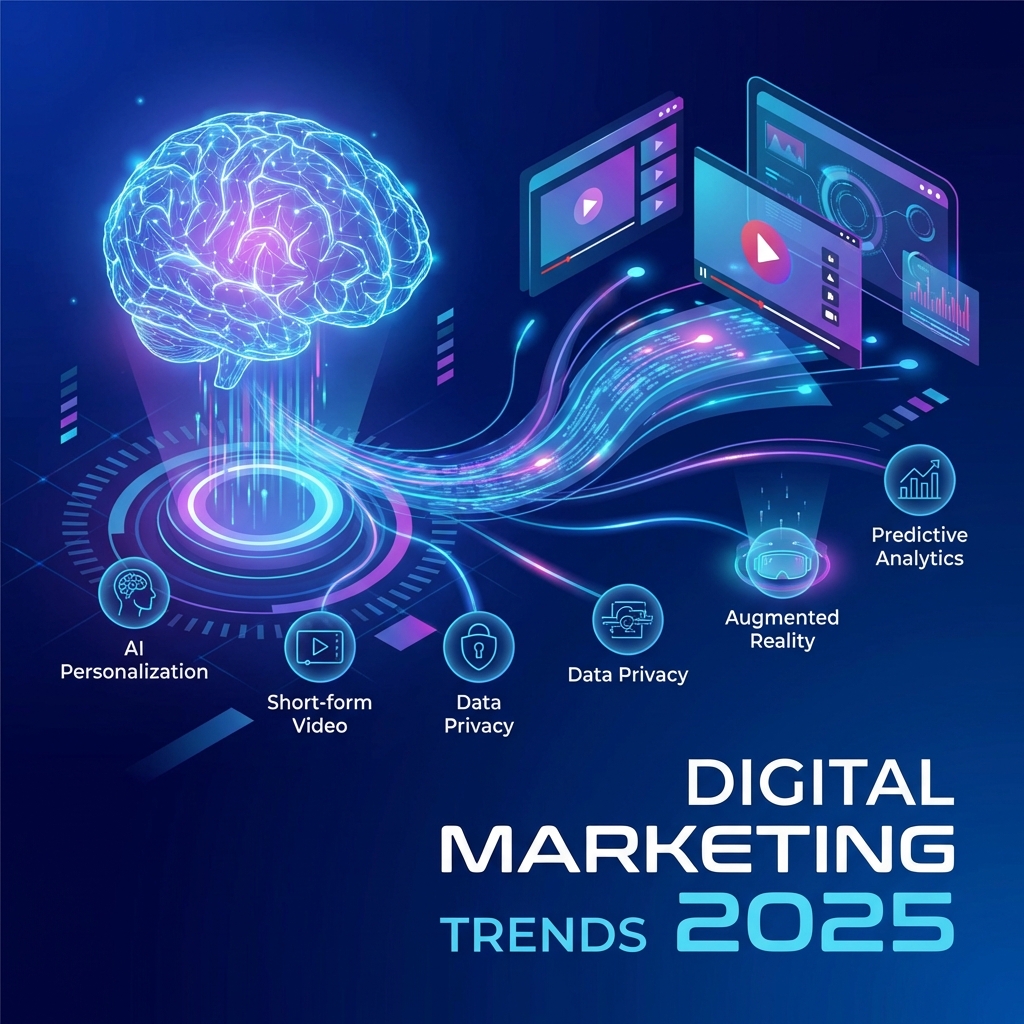
The 2025 Digital Marketing Landscape
Digital marketing in 2025 is fundamentally different from even two years ago. The convergence of AI maturity, privacy regulation enforcement, and changing consumer behavior has created a new paradigm where personalization must coexist with privacy, automation must feel human, and brands must balance performance with purpose.
The marketers winning in 2025 aren't just adopting new tools—they're rethinking entire strategies around these seismic shifts. They understand that consumers expect seamless omnichannel experiences, demand transparency, and will abandon brands that don't align with their values. They're leveraging AI not to replace human creativity but to amplify it
This guide explores the seven digital marketing trends reshaping the industry in 2025, providing actionable strategies to stay competitive and capitalize on these transformations.
Trend #1: AI-Powered Marketing Automation and Personalization
AI Marketing Revolution
Artificial intelligence has moved from experimental to essential. In 2025, AI powers everything from content creation to customer segmentation, predictive analytics to programmatic ad optimization.
Key AI marketing applications:
- Hyper-personalization at scale: AI analyzes thousands of data points to deliver individually tailored experiences to millions of customers
- Predictive customer behavior: Machine learning models predict purchase intent, churn risk, and lifetime value with 85%+ accuracy
- Content generation: AI writes first drafts of emails, ads, product descriptions, and blog outlines (with human editing)
- Intelligent chatbots: Conversational AI handles 70% of customer inquiries without human intervention
- Programmatic optimization: AI automatically adjusts bids, budgets, and targeting in real-time for maximum ROI
- Sentiment analysis: AI monitors brand mentions across channels, identifying reputation threats early
How to implement AI marketing:
- Start with AI-powered email marketing tools (Klaviyo, ActiveCampaign) for intelligent send-time optimization and content personalization
- Use AI writing assistants (ChatGPT, Jasper, Copy.ai) to accelerate content creation
- Implement predictive analytics in your CRM to identify high-value leads
- Deploy chatbots for tier-1 customer support and lead qualification
- Experiment with AI-generated ad creative and test against human-created versions
Companies using AI marketing tools report 30-50% efficiency gains and 15-25% improvement in conversion rates. The competitive advantage goes to those who blend AI automation with human creativity and strategic thinking.
Trend #2: Zero-Party Data and Privacy-First Marketing
The death of third-party cookies and stricter privacy regulations (GDPR, CCPA, etc.) have forced marketers to fundamentally rethink data collection. Zero-party data—information customers intentionally share—is now the gold standard.
What is zero-party data?
Zero-party data is information a customer proactively and intentionally shares with a brand. Unlike first-party data (observed behavior) or third-party data (purchased from data brokers), zero-party data includes:
- Preference center selections (email frequency, content topics, product interests)
- Quiz and survey responses revealing needs and preferences
- Purchase intentions shared through wishlists or "notify me" features
- Personal context provided through profile customization
- Feedback shared through polls, reviews, and ratings
Zero-party data collection strategies:
- Create interactive quizzes that provide value (product recommendations, personalized insights) in exchange for preference data
- Build comprehensive preference centers letting customers control their experience
- Use progressive profiling to gradually collect information over multiple interactions
- Offer exclusive access or rewards for completing detailed profiles
- Deploy polls and surveys that feel engaging, not intrusive
Brands excelling at zero-party data collection see 20-30% higher customer lifetime value because the insights enable genuinely relevant personalization built on explicit consent.
Trend #3: Conversational AI and Chatbot Evolution
Chatbots in 2025 bear little resemblance to the frustrating rule-based bots of 2020. Modern conversational AI understands context, handles complex queries, and delivers human-like interactions that customers prefer for many use cases.
Advanced chatbot capabilities:
- Natural language understanding: Comprehends intent even with informal language, typos, and multi-part questions
- Context awareness: Remembers conversation history and customer data to provide personalized responses
- Sentiment detection: Identifies frustrated customers and routes to human agents proactively
- Multi-language support: Communicates fluently in 100+ languages
- Omnichannel presence: Provides consistent experience across website, app, SMS, WhatsApp, and social media
Strategic chatbot use cases:
- Tier-1 customer support (password resets, order tracking, FAQs)
- Lead qualification and appointment booking for sales teams
- Product recommendations based on needs assessment
- Post-purchase support and upsell opportunities
- Event registration and information delivery
Trend #4: Short-Form Video Dominance
Short-form video—content under 60 seconds—has become the dominant content format across all platforms and demographics. TikTok's meteoric rise, combined with Instagram Reels and YouTube Shorts, has fundamentally changed how brands tell stories and engage audiences.
Short-Form Video Statistics 2025
- 60% of consumers prefer video content over any other format
- Short-form video drives 3-5x higher engagement than images or text
- 90% of TikTok users visit the app daily, average session: 52 minutes
- Brands using Reels see 22% higher engagement than feed posts
- Video content generates 1200% more shares than text and images combined
Short-form video best practices:
- Hook in 3 seconds: Capture attention immediately or users scroll
- Embrace platform trends: Use trending audio, effects, and formats
- Prioritize authenticity: Raw, genuine content outperforms polished production
- Add captions: 85% of video is watched without sound
- Focus on value: Educate, entertain, or inspire—don't just promote
- Maintain consistency: Post 3-5 videos weekly minimum for algorithm favor
Trend #5: Voice Search and Audio Content
Voice search continues growing with 50% of all searches expected to be voice-based by end of 2025. Smart speakers, voice assistants, and in-car systems are changing how consumers find information and make purchasing decisions.
Voice search optimization strategies:
- Target conversational, long-tail keywords that match natural speech patterns
- Create FAQ pages with question-and-answer format
- Optimize for featured snippets (position zero) which voice assistants often read
- Implement structured data markup to help search engines understand context
- Focus on local SEO for "near me" voice searches
- Ensure fast mobile page speed (voice search users expect immediate results)
Trend #6: Augmented Reality (AR) Experiences
AR has moved beyond novelty to practical tool driving measurable business results. Virtual try-ons, product visualizations, and interactive experiences reduce return rates and increase purchase confidence.
Effective AR marketing applications:
- Virtual try-on: Eyewear, makeup, clothing visualization increases conversion 40-50%
- Product placement: Furniture, appliances in actual space reduces returns 25-35%
- Interactive packaging: AR experiences activated by scanning product packaging
- Virtual showrooms: 3D product exploration from anywhere
- AR filters for social: Branded Snapchat/Instagram filters for shareability
Trend #7: Ethical and Sustainable Marketing
Consumers expect brands to stand for something beyond profits. Purpose-driven marketing isn't optional—73% of consumers will pay more for products from companies committed to positive social and environmental impact.
Ethical marketing pillars:
- Transparency: Honest communication about sourcing, pricing, and business practices
- Data privacy: Clear, simple privacy policies and user control over data
- Sustainability: Genuine environmental commitments, not greenwashing
- Inclusivity: Authentic representation in marketing content
- Social responsibility: Community investment and ethical labor practices